Showing posts with label vines. Show all posts

Technique for More Flowers from the Sandpaper Vine - Deadheading

There is a less-known technique for encouraging a wave of flowering for plants. If it is well-known, then I suppose it isn't practiced widely. That technique is called Deadheading. I wrote an article on Deadheading for More Flowers many years ago.

Over the years, I've done deadheading on the Cypress Vine (Ipomoea quamoclit), the Rose Cactus (Pereskia bleo), Maiden's Jealousy Vine (Tristellateia australasiae), and the Garlic Vine (Mansoa alliacea), among others. All of these yielded postive results.

This time, I'm writing on my experience with deadheading on the Sandpaper Vine (Petrea volubilis) also known as Purple Wreath or Queen's Wreath. By its nature (vigorous growth and sandpapery leaves), there are some specific considerations, and those too will be discussed.

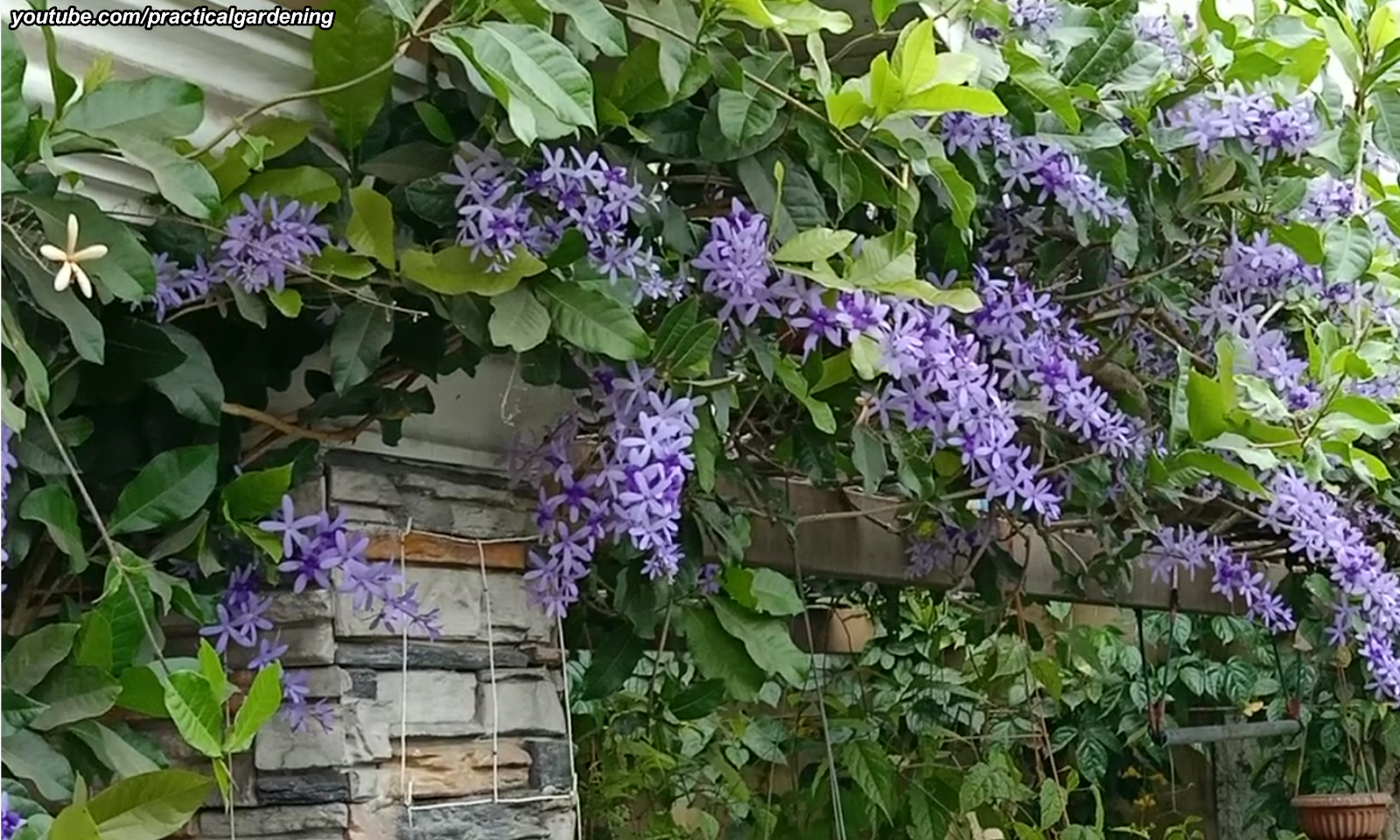
Wouldn't it be a gorgeous sight to have this display that greets you as you enter your home? And to have this sight a few times in the year at that!

How to Air-Layer Trees and Vines with Just Water

In a previous article, I mentioned how one could easily propagate the Bougainvillea with just water. There was one query asking if other garden plants would respond positively with this approach of propagation. In particular, the inquirer asked about the Gumamela, which is the local term for Hibiscus.

It was rather coincidental that I air-layered a Hibiscus plant with this water technique and sent her photos of the Hibiscus plant I successfully propagated. She was elated to know as she wanted to grow her Hibiscus collections.

It seems that common garden woody plants like the bougainvilleas and hibiscus respond well to air-layering with water. But how about the plants that potentially grow bigger, like vines and trees?

So I put that to the test with a very mature vine of ours which is the Sandpaper Vine or Petrea volubilis, shown below.

Intense Flowering of the Sandpaper Vine (Petrea Volubilis)

For a few days now, I've noticed that my Sandpaper Vine (Petrea volubilis) also known as Queen's Wreath has been flowering more than usual. I've had this vine for five years now and have taken interest especially on the vine's first flowering three years ago. It is only now that neighbors even took notice on the masses of flowers bloomed. Some passersby inquired on how it has flowered this way.


Single Trunk of the Sandpaper Vine (Petrea Volubilis) - Part 3

(This is the continuation of Part 2)

Removing the guide wire at the top portion of the Sandpaper vine was not as easy as I thought. What I was seeing at the lower portion of the vine's trunk was actually the easiest part.

The top part of the main trunk appears to have been tightly wound by the guide wire as shown below.

Single Trunk of the Sandpaper Vine (Petrea Volubilis) - Part 2

(This is the continuation of Part 1)

In addition to the bamboo stake that props up the young Sandpaper vine, I tied a guide wire on the top end of the bamboo stake and attached it to the vine structure or trellis above it.

The guide wire, which is really a trellis starter, is a dual purpose device. First, it allows the new shoot of the vine to climb it. And second, it correctly guides the Sandpaper vine towards the vine structure or trellis above it.

Single Trunk of the Sandpaper Vine (Petrea Volubilis)

When we bought our Sandpaper Vine (Petrea Volubilis), I already had an image of it when it matures and flowers. Of course, I didn't have an exact timetable for that. But I was thinking it would be around two years.

What I envisioned would be a flowering vine that more or less resembled a small tree. It would have a main trunk that will be as vertically straight as possible. Or the trunk may be composed of a couple of very thick branches probably entwined to one another.

Straighten the Bent Trunk or Branch of a Garden Plant - Part 3

(This is the continuation of Part 2)

Today, I finally removed the splint I devised to straighten a bent branches in a Sandpaper Vine (Petrea volubilis). Based on my observation of this vine from images on the internet, I noticed from the photos that the mature vine doesn't necessarily grow straight up.

Straightening and Healing a Broken Branch in a Vine - Part 2

(This is the continuation from Part 1)

  1. Ensure that the entire length of the leader branch is secured to the stake.

Straightening and Healing a Broken Branch in a Vine

A recent typhoon swept through our area this past week. It wasn't a particularly strong typhoon but it brought with it non-stop rains resulting in floods. One thing I noticed peculiar with this typhoon, at least in our area, is the presence of low but strong winds.

It is for this reason that many potted plants in our garden and at the sidewalk were toppled. One garden plant damaged by this typhoon is our newly repotted Bauhinia kockiana.

Repair a Rotted Built-in Bamboo Container Trellis - Part 2

(This is the continuation of Part 1)

Here is the procedure to repair a rotted bamboo trellis by removing the damaged parts and then replacing them with steel rods.

Repair a Rotted Built-In Bamboo Container Trellis

After over four years, the built-in bamboo trellis in a container that I built has shown signs of deterioration and damage. I wasn't surprised at which part of the bamboo trellis where the damage had occured. This is the part which gets wet and stays wet often - that part of the trellis that is staked in the pot's soil.

Straighten the Bent Trunk or Branch of a Garden Plant - Part 2

(This is the continuation of Part 1)

The double splint method of straightening the bend of the trunk or branch of a plant uses two straight and relatively rigid rods or slats. The branch or trunk is then "sandwiched" in between the two rod or slats. This is a stronger splint and prevents the tying material from touching the branch or trunk.

Straighten the Bent Trunk or Branch of a Garden Plant

In a previous article I outlined the steps in my procedure to propagate a Sandpaper Plant or Petrea Volubilis. In this article, I will discuss a technique to straighten the trunk of the Sandpaper Plant, sometimes called the Queen's Wreath or Purple Wreath.

It is a technique that can be applied to correct not only the trunk but to a severely cured branch as well. Also, this technique may be used for all types of semi-woody to woody garden plants. As long as the garden plants are young enough, then the curve may be corrected.

Techniques for Tidying Flowering Vines on the Front Fence

There's a gardener's saying that goes like this: “The first year they sleep, the second year they creep, and the third year they leap”.

The first season after you plant a vine, it may appear to be asleep above ground. Rest assured though that below ground their roots are very much awake. And they are growing larger and spreading throughout the bed in search of nutrients.

The second year, the year they creep, you will see additional growth above ground. This is because the roots are larger and can support a larger plant. Then, in the third year, when their roots are fully formed, the vine will seem to leap, assuming a fully mature size.

Bauhinia Kockiana - A Finicky Vine

Still reeling from that loss of a Bauhinia Kockiana vine, it would be over a year that I took another interest on this beautiful vine. This time, we had a chance to go to a garden show called the Los Banos Flower and Garden Show in Los Banos, Laguna. The garden show is held at the Social Hall inside the UPLB.

One of the stalls was selling a couple of Bauhinia kockiana's: a small one priced at Php150 and a bigger one at Php250. As I was still upset that my first expensive vine died almost two years ago without even flowering, I was wary. And so I just wanted to buy the smaller vine.

Waves of Flowering in the Garlic Vine (Mansoa Alliacea)

"Beautiful!" is all what my neighbors could mutter as they pass by our house and see the flower clusters of Garlic Vine (Mansoa Alliacea) cascading down the front fence. This year, the masses of flowers was truly exceptional. And what's nice about this is that there have been three waves of flowering since last month!

Ground-Layering Techniques Using Disposable Cups - Part 2

(This is the continuation from Part 1)

  1. While holding the disposable cup, punch several holes at the bottom of the cup by pushing the heated nail. The heated pointed end of the nail would melt the plastic of the cup. The size of the hole must be big enough for twist ties to pass through. The shape of the created holes is insignificant. Punch the holes about an inch apart from each other.

Ground-Layering Techniques Using Disposable Cups

The Mandevilla is one of our favorite vines. It comes in shades of red, pink, white and yellow. It is a rather finicky vine in that it cannot tolerate its roots being wet most of the time.

For this reason, several of my mandevillas were planted in garden pots in the porch. The roofed porch protects the mandevilla pot's soil from getting soaked from the strong rains. Its location, however, receives plenty of sunlight in the afternoon.

Rangoon Creeper (Quisqualis indica) Growing in an Arch or Arbor - Part 3

In part 2 of this article, I discussed the initial growth stages of the Rangoon Creeper vine, including its first flowering. Realizing the potential for this vine to become robust and aggressive, I thought pruning to create a more compact look for the trunk of the vine to make it look tidier and looking less overpowering than the rest of the nearby plants.

In this part, I'll discuss other ways to thin out the trunk portion of the Rangoon Creeper so it becomes less invasive. As mentioned repeatedly, the Rangoon Creeper, given the right amount of sunlight and watering, will grow quickly. The vine on your arch, arbor or pergola will look like a tangled mess without the proper control of the branches.

Rangoon Creeper (Quisqualis indica) Growing in an Arch or Arbor - Part 2

In part 1 of this article, I discussed the location where the Rangoon Creeper or Chinese Honeysuckle was planted. There is full day sunlight in this location and so I expect the vine to grow quickly and yield beautiful flowers.

Because the vine has twining young shoots, I tied a piece of insulated solid strand wire from the front fence near where its planted up to the top of the garden gate arch. The wire will be used to train the Rangoon Creeper's vine and reach the garden gate arch.